Home›Pest Blog›Termites in Singapore: Species, Signs and How to Get Rid of Them
TermitesPest Blog
Termites in Singapore: Species, Signs and How to Get Rid of Them
Singapore's tropical climate keeps termite colonies active 24 hours a day, year-round. This guide covers the three species found locally, how to identify each, the warning signs every property owner should know, and which treatment approach suits different property types.
👤
Innovative Pest Management
|📅 Updated March 2026|◯ 10 min read|🛡 NEA Licensed
3 Species
Termite types found in Singapore
24 hrs/day
Colonies feed without rest
2 million
Members in a mature subterranean colony
$5 Billion
Annual property damage worldwide
Termites are commonly called “the silent destroyers” because colonies feed continuously inside walls, floors and structural timbers without leaving visible surface damage until the harm is severe. In Singapore’s year-round tropical climate, there is no resting season. Understanding the species, the biology and the early warning signs is the first line of defence for any property owner.
✎Key Takeaways
✔Three termite species are active in Singapore: dampwood, drywood and subterranean. Subterranean (Coptotermes sp.) accounts for over 90% of infestations.
✔Termite colonies work 24 hours a day with no rest. Singapore’s humidity and heat mean there is no quiet season as there is in temperate climates.
✔Early signs include discarded swarmer wings near light sources, hollow-sounding wood when tapped, mud tubes on walls and frass (droppings) near timber.
✔Swarming peaks between April and July. Seeing swarmers indoors is a reliable indicator that an established colony is active in or near the building.
✔Treatment choice depends on the species and property type. Baiting targets the colony directly. Soil treatment creates a protective barrier. Both are often used together.
01. What Are Termites?
Termites are social insects that live and work as a colony. Every member has a specific role: the queen and king reproduce, workers forage and feed the nest, soldiers defend against threats, and reproductives (swarmers) periodically leave to found new colonies. The total biomass of all termite colonies worldwide exceeds that of all humans combined, and approximately 2,000 species have been identified globally.
What makes termites particularly damaging in Singapore is the combination of large colony sizes, year-round activity driven by tropical climate, and their ability to remain completely hidden until structural damage is already advanced. Unlike many pest infestations, termites leave almost no surface evidence while feeding, which is why they are consistently referred to as silent destroyers.
Singapore’s climate factor: With temperatures rarely below 22 degrees Celsius and relative humidity consistently above 75%, Singapore’s environment supports continuous colony growth year-round. There is no winter slow-down. Termite damage accumulates at rates that can compromise structural integrity within three to five years of infestation.
02. Dampwood Termite in Singapore
Dampwood Termite
Archotermopsidae
Moisture-associated
SIZE
1/2" to 5/6"
SHAPE
Long, narrow, oval
COLOUR
Brownish beige
DIET
High-moisture wood and cellulose. Lives in colony. Requires consistently wet conditions to survive.
HABITAT
Damp logs, decaying wood and old standing dead trees. Enters buildings through timber in direct contact with soil or where plumbing leaks provide a constant moisture supply.
IMPACT
Builds mud tubes in wet conditions to connect nest chambers to food sources. Feeds 24 hours a day, leaving costly structural damage. Frass (waste pellets) are expelled away from the nest.
PREVENTION
Remove unused timber scrap from the property. Seal cracks and crevices around the building exterior. Fix all plumbing leaks and ensure drainage directs water away from foundations. Eliminate any wood-to-soil contact around the perimeter.
ⓘ
DID YOU KNOW? Dampwood termites have been present on earth since the time of the dinosaurs, making them one of the oldest groups of social insects still alive today.
03. Drywood Termite in Singapore
Drywood Termite
Cryptotermes sp.
Sporadic — often imported
SIZE
3/8"
SHAPE
Long, narrow, oval
COLOUR
Light brown
DIET
Dry timber, kitchen cabinet materials, plastics and plant-derived fabrics. Does not require soil moisture to survive.
HABITAT
Dry timber, furniture and structural timbers entirely above ground. The nest does not need to contact soil. Termites build mud tunnels to move between chambers and food sources. Frequently introduced into Singapore through imported solid wood furniture.
IMPACT
Nests and digs tunnels within walls and structural timber. Workers consume wood from inside, weakening load-bearing elements while leaving the surface largely intact. Hexagonal frass pellets near timber are a reliable identification indicator.
PREVENTION
Store timber materials securely. Seal all entry points, cracks and crevices. Inspect imported furniture before bringing it indoors. Drywood termite frass pellets are easily detectable during a professional inspection.
ⓘ
DID YOU KNOW? Drywood termites mate for life. Once a pair establishes a nest, they remain together as the colony’s founding king and queen for the entire lifespan of the colony.
04. Subterranean Termite in Singapore
Most destructive species in Singapore. Subterranean termites account for over 90% of all local termite infestations and are responsible for the vast majority of serious structural damage reported to pest professionals.
Subterranean Termite
Coptotermes sp.
Over 90% of all infestations
SIZE
1/8" to 1/9"
SHAPE
Long, narrow, oval
COLOUR
Creamy beige to brown
DIET
Cellulose found in wood, wallpaper, fabric and any plant-derived material. A single mature colony can consume over 400 grams of wood per day.
HABITAT
Underground or in damp areas above ground. Must maintain contact with the earth to regulate moisture. Builds mud tubes from soil and saliva to reach above-ground food sources while retaining humidity.
IMPACT
The most destructive termite species globally. Colony can reach 2 million members. Targets building foundations, wooden frames, flooring, insulation, plumbing linings and living trees. Works continuously without rest, causing damage that accumulates silently until structural failure becomes apparent.
PREVENTION
Ensure all water drains away from the property foundation. Repair dripping taps and address any ground moisture issues immediately. Do not allow water to pool around the base of the building. Replace any damaged or damp exterior timber. Dispose of wood scraps around the property.
ⓘ
DID YOU KNOW? Subterranean termites target any source of cellulose, not just timber. They have been documented consuming wallpaper, cardboard, books, insulation and even the paper wrapping around electrical cables.
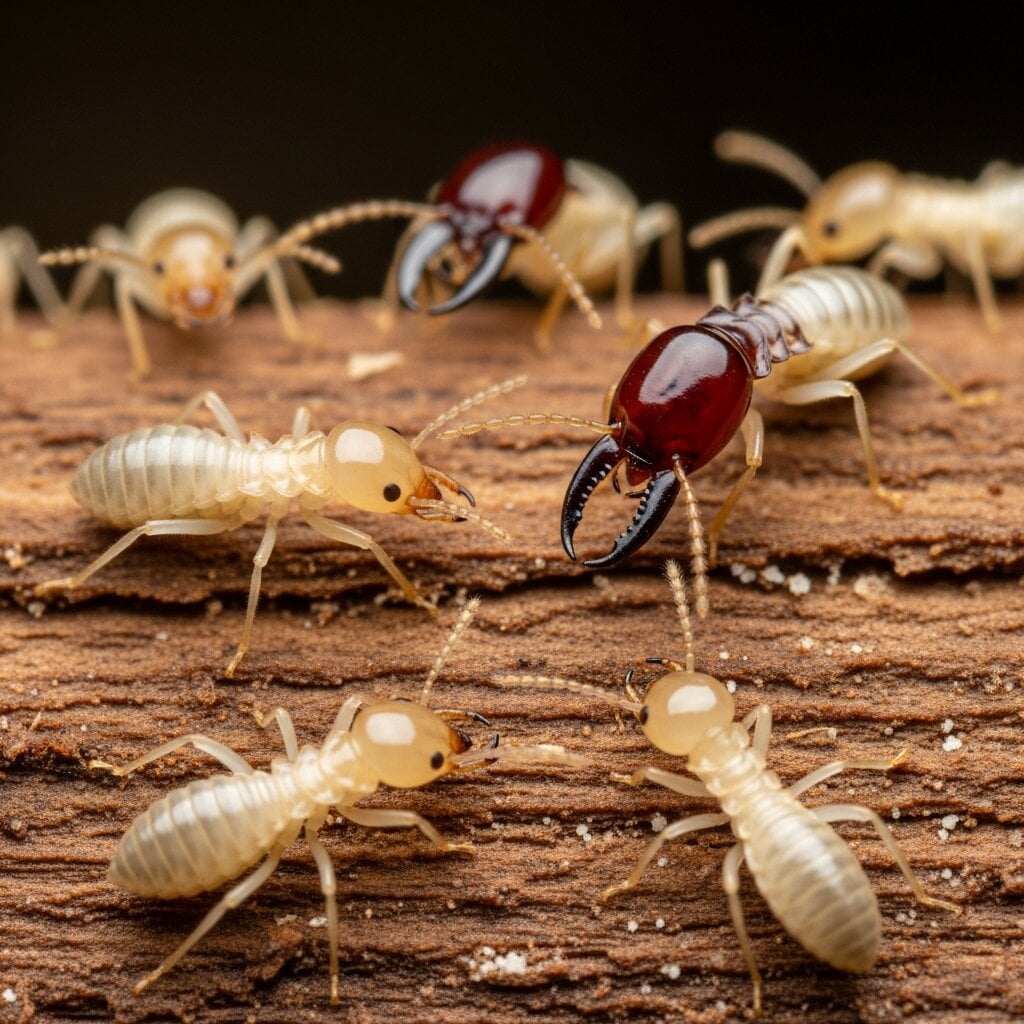
The subterranean termite colony is divided into four castes. The queen and king handle reproduction — the queen can lay thousands of eggs daily. Workers forage and feed the colony, and are the primary targets of baiting treatments. Soldiers defend the colony and cannot feed themselves. Reproductives (swarmers) leave the colony in mating flights to found new nests.
05. Signs of Termite Activity in Singapore
Most property owners do not notice a termite infestation until the damage is already significant. These are the key indicators to look for during routine checks:
👆
Discarded wings near windows and light fittings
When reproductives swarm, they shed their wings immediately after landing. Piles of wings near entry points or light sources indicate that a swarm has occurred recently and a colony is active nearby.
●
Mud tubes on walls, foundations and pipes
Subterranean termites build protective mud tubes from soil and saliva to travel between their underground nest and above-ground food sources. Mud tubes on exterior or interior walls are a reliable indicator of subterranean termite activity.
🔒
Hollow-sounding wood when tapped
Termites feed from the inside outward, leaving a thin surface skin intact. Wood that sounds hollow or papery when tapped has typically been extensively consumed. Door frames, skirting boards and timber flooring are the most commonly affected areas.
■
Frass near timber surfaces
Drywood termites push their hexagonal frass pellets out of small holes near the nest. Finding small piles of what looks like fine wood dust or sand-like granules near timber furniture or structural wood is a specific sign of drywood termite activity.
🐛
Swarming events indoors (April to July peak)
Seeing flying termites inside a building, particularly near light sources, is one of the clearest signs of an established nearby colony. Swarming peaks during Singapore’s inter-monsoon months but can occur at any time of year.
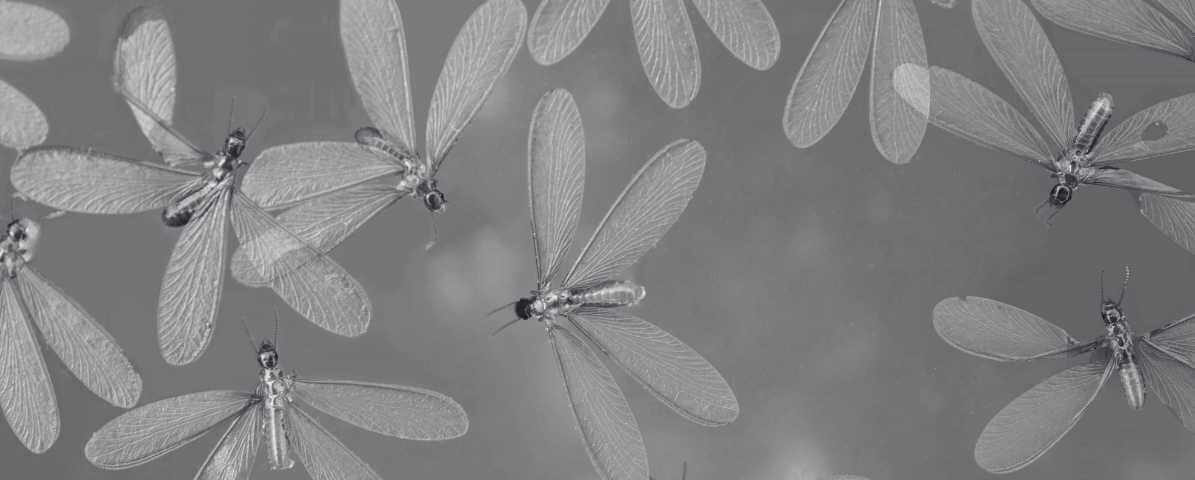
Important: Termites are commonly mistaken for flying ants during swarming events. Termite swarmers have straight antennae, equal-length wings and a broad abdomen with no pinching at the waist. Flying ants have elbowed antennae and a distinctly pinched waist. If you are uncertain, do not disturb the insects. Photograph them and contact a licensed pest specialist for identification.
Our NEA-licensed specialists identify the species, locate the activity zone and provide a written inspection report with treatment recommendations. Same-day availability for urgent cases.
NEA-licensed technician performing corrective anti-termite soil treatment in Singapore
06. Which Treatment Suits Your Property?
The right termite treatment depends on the species identified, the extent of infestation, the property type and whether the goal is elimination, prevention or both. The following is a general guide. A licensed inspection is always required before any treatment recommendation can be confirmed.
Property Type
Recommended Approach
HDB Flat
Termite baiting — no subfloor access required. Bait stations placed at accessible ground-level perimeter points.
Condominium
Termite baiting — coordinate with MCST for perimeter station placement. Above-ground stations deployed at active sites indoors.
Landed Property
Soil treatment combined with baiting for comprehensive protection. Soil treatment covers the perimeter barrier; baiting targets any active colony.
New Construction (pre-slab)
Pre-construction soil treatment applied before the concrete slab is poured. This is the most effective and cost-efficient point of intervention.
Commercial Building
Soil treatment with reticulation system for the perimeter plus an ongoing baiting programme for active infestation management.
Post-Renovation
Inspection and corrective soil treatment if the renovation disturbed existing treated soil. Baiting for any newly active colonies detected.
07. Frequently Asked Questions
The subterranean termite (Coptotermes gestroi) accounts for over 90% of infestations in Singapore. Drywood termites (Cryptotermes sp.) are the second most common, typically introduced through imported timber furniture. Dampwood termites appear less frequently and are associated with properties with persistent moisture problems such as leaking pipes or poor drainage.
Termites and flying ants are commonly confused during swarming events. Key differences: termite swarmers have straight antennae, equal-length wings and a broad waist with no pinching. Flying ants have elbowed antennae, unequal wings and a pinched waist. Termite swarmers also shed their wings shortly after landing. If you find discarded wings near window sills or light fittings, termites are the more likely cause.
Swarming events peak between April and July during Singapore's inter-monsoon period when temperatures and humidity are at their highest. However, termite colonies remain active and destructive year-round. Swarming is a sign that a nearby colony has matured and is founding new nests. Seeing swarmers indoors is a strong indicator that an established colony is present in or near the building.
Yes. Concrete and brick structures are not immune. Subterranean termites travel through expansion joints, pipe penetrations and hairline cracks in concrete slabs to reach timber elements above. They target timber roof trusses, floor joists, door frames, skirting boards and any cellulose-based material including drywall paper and insulation. The concrete itself is not consumed, but termites exploit any gap to access the timber within.
Soil treatment creates a chemical barrier around a building's foundation by injecting termiticide into the soil. It repels or kills termites that attempt to cross the treated zone but does not eliminate the colony. Termite baiting uses a slow-acting insect growth regulator that foraging workers carry back to the colony and share through trophallaxis, eventually reaching and eliminating the queen. Baiting is generally preferred for active infestations in existing buildings. Soil treatment is the standard approach for new construction.
NEA Licensed Termite Specialists Singapore
Protect Your Property from Singapore's Silent Destroyers
Termite damage in Singapore accumulates silently and becomes costly before it is visible. A professional inspection identifies the species, maps the activity zone and determines the right treatment before structural damage occurs. Early action is always less expensive than repair.
I am committed to turning complex pest-management insights into clear, practical information that anyone can understand. Through my work, I aim to empower homeowners and businesses to make informed decisions that protect their health, property and environment.